

圣盖博谷佛教地图绘制项目
圣盖博谷佛教地图绘制项目
ISHB的圣盖博谷佛教遗址测绘项目由卢斯基金会(Luce Foundation)通过亚太裔美国人宗教研究计划 (APARRI ) 资助。该项目旨在收集南加州佛教遗址丰富多样的空间数据。研究结果表明,圣盖博谷拥有超过100座佛教寺庙。
主要研究人员:Jens Reinke、Jane Iwamura
研究员:王松
第一阶段 · 1. 简介
大洛杉矶地区是全球最多元化的宗教大都市之一。自1965年美国移民法改革以来,来自台湾、香港、中国大陆、越南以及东南亚各地的亚裔移民汇聚于圣盖博谷,建立了数以百计的佛教寺庙、禅修中心与居士精舍。

圣盖博谷作为亚裔美国人族裔空间的根源,可以追溯到上世纪中叶美国移民法的变革。从20世纪60年代开始,受国际地缘政治和全球经济变化的影响,全球亚洲移民的人口结构发生了重大变化。美国出台的新移民法将目标对准了高技能专业人士以及富裕群体。此外,新法律还允许家庭赞助的移民以及劳动力短缺领域的低技能专业人员移居美国。其结果是,亚裔美国人社区在社会阶层上变得更加分化。
以华裔移民为例,他们在不同时期来自不同的原籍地区。第一波移民来自台湾和香港,随后是来自东南亚的华裔,而近期的移民则来自中国大陆的不同省份。因此,华裔美国人社区的文化、地理和海外社会经济背景明显变得更加多元化。这些变化也伴随着新的居住模式。19世纪来自南方沿海省份的华人定居在市中心的唐人街,而新的华裔移民则直接搬到了美国大都市区的郊区。在美国,这群全新且规模最大的华裔郊区住宅和商业集群就位于圣盖博谷。美国地理学家李唯(Wei Li)将这种发展现象称为“族裔郊区”(ethnoburb)。在这个全新的郊区空间形成过程中,宗教发挥了重要但尚未得到充分研究的作用。
3. 研究方法(数据源)
该项目由西来大学(University of the West)的人类学佛教研究所(ISHB)组织开展。项目由伯克利·露斯基金会(Berkeley Luce-Foundation)通过亚太裔美国人研究倡议(APARRI)提供资金支持。作为人类学佛教研究所的前任所长,Jens Reinke 教授担任首席研究员。主要的博士生研究员是西来大学宗教研究系的博士生王松。
我们在该项目中主要利用了三个数据来源:
-
互联网上易于获取的数据,包括谷歌地图(Google Maps);
-
《华人工商电话簿》(Chinese Consumer Yellow Pages),这是一个综合性的当地中文商业名录;以及
-
当地寺院的知情人士。
数据源(1)的获取非常直接。我们开发了一套包含英语、中文、越南语、泰语和日语的关键术语,并将其输入到常用的搜索引擎中。数据源(2)的操作也并不复杂,因为黄页中包含了该地区寺庙的地址和联系信息。最宝贵的数据源是(3)当地寺院的知情人士。西来大学位于佛教圣盖博谷的核心地带。作为一所由佛教徒创立、设有宗教研究系和心灵关怀/神职系(Chaplaincy Department)的非宗派大学,西来大学拥有非常国际化的学生群体。绝大多数国际学生来自佛教人口显著的亚洲国家。此外,上述学系的大量学生都是佛教出家人(僧侣),其中许多人就居住在当地的佛教寺庙中。这些联系不仅在提供进一步数据方面非常有帮助,而且在核对数据源(1)和(2)的数据时也起到了关键作用。
从历史发展的角度来看,圣盖博谷不仅是一个市政概念,也是一个地理概念。圣盖博谷得名于自北向南流经该谷中央的圣盖博河,而这条河流本身又是以西班牙传教站“圣盖博大天使”(San Gabriel Arcángel)命名的,该传教站最初于1771年建于惠蒂尔隘口(Whittier Narrows)。随着市政规划的发展,该地区的范围也在不断演变。因此,在我们的实际调研中,我们并没有死板地划定该地区的边界,而是将一些不在该地区边界内、但在附近的地点也纳入了进来。
在22/23学年的后半学期,我们开车在圣盖博谷巡访,以确保我们的数据是最新的。在这个初步阶段,我们主要感兴趣的是评估地理分布、基本特征(关于国籍、宗派和学派)以及不同的建筑风格。这些数据被录入到谷歌地图上一个初步的自定义地图中。在近期阶段,我们正在开发一个 ArcGIS 平台来整合这些数据。
-
寺庙分布:我们通过搜索引擎、黄页、官方网站、谷歌地图等渠道核实了寺庙的地址和分布,并进行了实地考察以验证信息的准确性。
-
寺庙的国籍、宗派和学派:根据标牌、使用的语言、国旗、官方网站、进一步的在线资源以及知情人士提供的信息,我们发现了来自以下国家或传统的佛教寺庙。
-
建筑风格:由于许多寺庙是在后来的移民潮之后建立的,其中相当一部分是通过购买现有房产而建成的,从而导致寺庙结构背离了传统外观。通过实地调查,我们记录并分类了几种独特的寺庙建筑形状和结构。
在2023年秋季学期,我们的重点正在转向华裔美国人佛教寺庙,对常住僧侣人数、主要使用语言、精神领袖或其宗派传承、寺庙落成年份以及其他相关信息等具体细节进行深入调查。
4. 研究结果
4.1 寺庙分布
在实地考察后,我们从初步名单中总共确认了近100个有效的寺庙选址。在市政地理方面,我们的研究范围也包括了洛杉矶县的一部分,但并非全部。洛杉矶县东部的一些寺庙会与圣盖博谷的范围重叠。虽然洛杉矶市和橙县(Orange County)有更多的寺庙,但目前我们专注于圣盖博谷的范围。
这些寺庙分布在整个山谷中,其中最集中的地区是埃尔蒙特(El Monte)、罗斯米德(Rosemead)、波莫纳(Pomona)和拉普安特(La Puente)。其次是西科维纳(West Covina)、蒙特利公园(Monterey Park)和阿尔罕布拉(Alhambra),各拥有5座寺庙,随后是阿苏萨(Azusa)和帕萨迪纳(Pasadena),各拥有4座。
由于我们适度地将圣盖博谷的地理范围扩大到了洛杉矶县,而洛杉矶县是一个相当大的地理区域,因此多达15座寺庙进入了我们的名单。此外,仅凭城市边界来区分数量仍然不是非常客观和全面,因为许多小城市的边界往往极其不规则,且相互交错嵌入。此时,我们可以从宏观的鸟瞰角度来分析地图,发现整体上呈现出“东少西多”的格局。除了市中心(Downtown)区域外,罗斯米德和埃尔蒙特地区成为了继市中心唐人街之后的“后唐人街”(post-Chinatown),并以此向外辐射,聚集了数量最多的寺庙。

4.2 Temple National Origin, or Lineage, and School
Based on the signage, language(s) present, national flags, official websites, further online sources, and informants, we found Buddhist temples from the following countries or traditions: There were 13 from mainland China, 23 from Taiwan, and 18 from Vietnam, these three categories being the most numerous. They are followed by 12 from Tibetan Buddhism, 9 from Japan, 8 from Myanmar, and 5 from Thailand, respectively. Finally, there are small numbers from Sri Lanka, Laos, Cambodia, and Australia.

However, there are limitations in distinguishing the lineage and origins of these temples by their countries alone, so we need to mix in elements of their traditions. In the case of Tibetan Buddhism, for example, some temples in the Tibetan Buddhist tradition are from India, some are from Vietnam, and most of them can be traced back to mainland China. Therefore, the classification of Tibetan Buddhism is more comprehensive to define, while more detailed factors may need to be investigated further to complete a full picture. In another case, for example, temples from some other countries, such as Australia, Vietnam, etc., actually came originally from the Chinese Mahayana tradition, such as the Amida Society (Jingzong xuehui 淨宗學會) of Ven. Jing Kong 淨空, whose nationality was later changed to Australia. There are also temples founded by a monastic born in China before 1949. Later, the monastics moved to Southeast Asia where they founded a Buddhist organization. But if we adopt the categorization of the Chinese Mahayana tradition, we will merge too many temples and lose too much information. To avoid oversimplifying the discussion, their dual nature will be listed and considered separately.
There are also great differences within a single country. For example, Vietnamese temples might be identified as northern Vietnamese, southern Vietnamese, or Sino-Vietnamese. So, this part requires further refinement in our follow-up work.
What's more, there are more difficulties and ambiguities with the data when tracing the identity of legal persons or founders of the temples. It may happen that a temple has two or more founders, or that a spiritual leader exists above the founders. In addition, many temples in North America have a system that mimics modern enterprises and also have their own board of directors, in which case they have a plurality of identities and countries of board members.
Another important phenomenon is the shifting of ownership. As mentioned above, the earliest ethnic Chinese inhabitants in the San Gabriel Valley after 1965 were Taiwanese. Many of the earlier Taiwanese migrants, including those who are monastics, have reached retirement age. This development is contrasted by the more recent rise of migration from the PRC. If it is a residential-sized vihara with one person living in it, it is likely to happen that the venerable will sell the temple property when he or she reaches retirement age, and so on. As a result, we can see a drastic change in the demographics of temple visitors and even temple ownership. Further research is needed to deal with these questions.
4.3 Architecture
In terms of architecture, we assessed five main styles:
(1) Buildings built in a “traditional” Asian Buddhist temple style;
(2) residential homes turned into temples that possessed recognizable visible markers such as signs, lanterns, and statues;
(3) churches turned into temples that possessed recognizable visible markers such as signs, lanterns, and statues;
(4) commercial buildings turned into temples that possessed recognizable visible markers such as signs, lanterns, and statues; and
(5) residential buildings without any such markers. In the future, it could be assessed how architectural style relates to local zoning residential (e.g., residential or commercial) in the different cities.
It's worth noting that if it's a commercial building, the primary way to identify it is by its exterior appearance, looking for any obvious signage. However, most Buddhist temples, even if located within a commercial building, have likely undergone interior renovations. This, however, is outside the scope of our research. While the majority are Buddhist temples, one was categorized separately as a "temple" because it is not Buddhist.


Buddhist Temple
Ming Ya Buddhist Association 佛学明月居士林
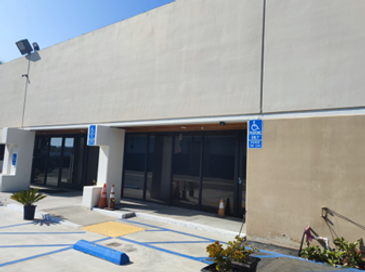
Commercial Building
Bliss Wisdom Los Angeles(BWLA)洛杉磯福智基金会

Renovated from Residential House
草堂寺
Residential House
American Avatamsaka Association

Renovated from Church
Mindfulness Meditation Center (Los Angeles Buddhist Vihara) Tian Ann Temple 天恩圣道院
5. Future Outlook
At this point, the research project is still in its preliminary state, and there are several possible future directions: The first is to get more quantitative data on the temples. For example, when were the temples founded? Are their resident monastics present? If so, how many are the venerables, or what kind of languages they can speak? How big are the temples? How many activities take place? Another important step would be to extend the geographical scope of the project to Los Angeles City, Orange County, San Diego, the Inland Empire, and the Bay Area. Besides temples, what other Buddhist spaces are there (vegetarian restaurants, schools, shops, medical spaces, etc.)
In addition, several qualitative questions arise from our preliminary fieldwork visits. How do the changing dynamics between Taiwanese and PRC Chinese Buddhists play out within the temple spaces? What kind of collaborations take place? Are there tensions? Are there different levels of adhering to monastic discipline? Maybe even more importantly, how do these spaces relate to the flourishing lay Buddhist life in the San Gabriel Valley? What is the role of age and gender? These are just some of many more possible research questions. We anticipate future studies that delve into the exploration of the vibrant Buddhist life in the San Gabriel Valley.
Bibliography
-
Li, Wei. Ethnoburb: The New Ethnic Community in Urban America. University of Hawaii Press, 2008.
-
Sassen, Saskia. "The Global City: Strategic Site, New Frontier." In Managing Urban Futures, pp. 89-104. Routledge, 2016.
Phase II
1. Introduction
Based on the initial survey of all Buddhist temples in the San Gabriel Valley during the first phase, there is a preliminary understanding of the number, diversity, and dispersion patterns of Buddhist spaces in the area. The second phase will focus specifically on Chinese American temples for a deeper investigation.
This phase of work will require a more in-depth approach involving interviews and research into the Chinese American temples, including the lineage or spiritual leaders, the establishment year and phase, the number of resident venerables, and the primary languages used. These data points will help analyze the components, processes, and current status of Chinese American Buddhism in the United States. Furthermore, contextualizing the data will involve exploring how the San Gabriel Valley forms a layered and complex Buddhist social space, linking Buddhism in the US with global China as a transnational spatial order.
2. Methodology
In the second phase, some detailed information had to be obtained through face-to-face interviews, phone calls, or informant information. Therefore, the research scope was narrowed to focus on the development of Buddhist temples among Chinese Americans.
In terms of research methods, besides visits of outside buildings, to understand specific information about the temple's lineage, founders, founding years, resident numbers, and languages used, I needed to delve into the temples and interview relevant responsible persons to gather information.
Some information could be directly obtained from the official websites, but many details, especially about the number of resident monks and languages used, were often incomplete.
It is worth noting that during this more in-depth investigation, some sensitive information might involve venerables or persons in charge unwilling to be interviewed or disclose specific details.
Additionally, some temples are closed or have no public contact information, resulting in incomplete data.
Therefore, data analysis needs to filter out invalid samples, and we ended up with about 40 valid samples.

Buddha Temple 佛祖寺 was closed
It is worth mentioning that during the investigation, new findings were made on some results from the first phase, so further corrections were made.
For example, some temples' national regions or lineage affiliations, or some temples were found to be unmanaged or temporarily closed.
Lien Guo Temple 莲果寺 was previously considered as the Chinese Han Mahayana Buddhism system, but actual investigation found it belongs to the Tibetan system, following Yundan Trinley Dorje Rinpoche 元丹欽列多吉仁波切.
Also, for example, Yanshou Temple was temporarily closed due to the aging of the venerables.

Yanshou Temple
3. Results
3.1 Distribution of Chinese American Buddhist Temples
First, regarding the urban distribution of Chinese American Buddhist Temples, similar to the distribution of all Buddhist temples, Chinese temples are mainly located in cities like El Monte, Los Angeles, and Rosemead. These areas are also the main Chinese residential areas, aligning with the historical narrative of Chinatown's migration from downtown to the suburbs. Additionally, the further east you go, the sparser the temples become.

3.2 Lineage Source
Regarding the statistics of the lineages, Taiwan accounts for the majority, followed by Vietnam and mainland China. This statistic mainly depends on the background of the founders. As the second and third generations develop, the composition of new members or the background of board members becomes more complex, making actual data analysis more complicated.


Interestingly, the Vietnamese background in Chinese Americans also has a certain hybridity because many who immigrated from Vietnam are Vietnamese Chinese, who still maintain the main characteristics of traditional Chinese in terms of cultural traditions, religious practices, etc. In Buddhist temples, unlike pure Vietnamese temples, they show Chinese traits in temple signs, architectural styles, venerables' ethnicity, languages used, etc.
It is worth noting that among the Chinese Vietnamese, a strong force comes from the Guangdong Chaozhou region, similar to Ming Ya Buddhist Association 明月居士林 and Buddha Monastery Support Association 观音精舍, all closely linked to the clan culture of Guangdong.

Chaozhou 潮州 Guangdong
The Vietnamese Ming Ya Buddhist Association (also known as Ming Yue Benevolent Society) is a religious sect of the Chaozhou Chinese community, integrating Chinese Buddhism, Taoism, folk beliefs, Japanese Esoteric Buddhism, and Pure Vietnamese Pure Land Buddhism. The Ming Ya Buddhist Association was introduced and developed in a multicultural context and was registered as part of Buddhism in 1954.
As an extension of Chinese culture, the Ming Yue Benevolent Society emerged, developed, and spread during times of turmoil and war, introduced to Vietnam with Chinese immigrants. In later stages, the Vietnamese Ming Ya Buddhist Association maintained its Buddhist nature to be recognized and developed while retaining its religious form. Additionally, with immigration, the Vietnamese Ming Ya Buddhist Association spread to Canada, the United States, and Australia in the 1980s, forming a transnational network.
— 阮玉诗 (Nguyen Ngoc Tho)

Ming Ya Buddhist Association 佛学明月居士林

Its Chinese Website
Another case is Lu Mountain Temple 庐山寺 and Wei Mountain Temple 沩山寺, which were included in the sample because their abbot, Ven. Yonghua, once took refuge under Ven. Hsuan Hua 宣化上人 at City of Ten Thousand Buddhas in San Francisco. Their Buddhist system mainly follows the lineage of Ven. Hsuan Hua's Chinese Han Mahayana.
Another temple, Bodhi Temple (Los Angeles Buddhist Union), is run by a monk of Sri Lankan background, but he studied in China, so his main practice system also conforms to the characteristics of Chinese Han Mahayana.

Ven. Yonghua

Ven. Zhaochu
An interesting phenomenon is that the two largest temples founded by Taiwanese monks—Hsi Lai Temple 西来寺 and B.O.C.A Dharma Seal Temple 法印寺—have male monks from mainland China as their current abbots after several transitions.

Abbot of Hsi Lai Temple
Abbot of Dharma Seal Temple
3.3 Development and Relocation Trends
Since the 1960s and 70s, some temples have grown from nothing, from small to large, gradually expanding or relocating due to funding limitation and space needs. Analysis of valid data shows that nearly 45% of the temples have relocated or have two or more addresses in Los Angeles. Most temples sold their previous smaller sites to raise funds to establish larger ones, while some manage two sites simultaneously.


In 2006, the city of Walnut rejected a permit application for the construction of Chung Tai Monastery 中台寺, citing concerns about traffic congestion and noise pollution. However, the city later approved the construction of a larger Catholic church and shopping complex. The temple filed a lawsuit with the Department of Justice and won.

Middle Land Chan Monastery 中洲禅寺, Pomona
Both Hsi Lai Temple and Yuan Yung Temple faced significant opposition from the public and religious communities. After numerous public hearings and resident coordination meetings, it took 8 years for the temples to be approved.
3.4 Historical Process of Temple Establishment
Historically, Chinese Buddhist temples in the SGV area gradually came to the United States since Ven. Hsuan Hua's preaching, peaking in the 1990s before gradually declining. Taiwanese temples entered earlier, followed by Chinese Vietnamese. Mainland Chinese temples entered in large numbers after the 21st century.

Timeline of the Chinese Temples' Establishment
To accurately and vividly display the founding locations and chronological order of these temples on a map, this project specifically uses a timeline-enabled map format.
However, during the research process, some founding year data information was missing, so relevant points had to be removed. Additionally, for temples that underwent relocation or are still under construction, the time point is generally based on the initial founding date. However, this doesn't fully represent the continuous process of a temple, which includes different locations at different times. Due to technical limitations, the geographical point linked to the initial founding time is indeed based on the final relocation position.
3.5 Organizational Structures and Member Composition
3.5.1 Headquarters
As one of the most important cities in the United States, Los Angeles has a large Chinese population, often becoming a bridgehead for major Buddhist organizations to propagate in North America. Organizationally, more than 40% of the temples have a headquarters-branch relationship.

Hsi Lai Temple serves as the North American headquarters of Fo Guang Shan and is affiliated with the headquarters in Kaohsiung, Taiwan.
Of course, there are also some unique affiliations. For example, the Yiguandao temples do not necessarily belong to the same sect, with different headquarters in Taiwan.
The Amida Society 净宗学会, though it has branches worldwide, is relatively independent and not under a unified hierarchy.
Additionally, the International Lingqi Buddhist Association灵祇精舍, though affiliated with Ven. Juelin 觉林 from mainland China, functions more like a lay organization devoted to Ven. Juelin, who visits regularly without resident venerables inside.
3.5.2 Lay Practitioner Leadership
According to statistics, more than 30% of the organizations are led, founded, or have main board members who are lay practitioners.
Examples include the Amida Society and Guanyin Citta LA 观音堂. The Bliss Wisdom Los Angeles(BWLA)洛杉磯福智基金会 was founded by Ven. Richang 日常法师 and later transferred to a female layperson.

Miaojue Temple was founded by Chinese Vietnamese nun Ven. Chuanjue 传觉. Although it is now managed by three mainland Chinese monks, the main shares of the temple were inherited by a lay relative of the nun. Therefore, the current monks do not own the property or shares but more like have an "employment relationship."
3.5.3 Gender Distribution of Resident Venerables
Overall, the statistics on residential venerables show that only over 20% are male monks. This indicates a general shortage of male monks, which helps explain why the two largest temples replaced their abbots with male monks from mainland China.
Regionally, Chinese temples related to Taiwan and Vietnam have far more female than male monks. In contrast, mainland Chinese temples have more monks than nuns (balanced). According to the details, the three mainland monks in Miaojue Temple, classified under Vietnam, are included in the mainland category for analysis.
If the organization is lay-related, excluding the special example Yiguandao, most of all lay organizations do not have resident members in their buildings. Lay practitioners usually have family lives and separate their activities from the organization's schedule.


3.5.4 Small “Residential House Temple” (or Vihara 精舍) Model
Excluding lay organizations, over 60% of temples have only one or two resident members, usually small in scale and often renovated from residential houses, resembling a “family temple” model.

3.6 Language Proficiency
Although nearly half of the staff in Chinese American Buddhist Temples can use English, about 37% of the temples or organizations have staff or venerables who are not proficient in English. Due to its large scale, Hsi Lai Temple has monks and volunteers from various regions and backgrounds who can speak multiple languages to receive visitors.

-
Interested in using our data or maps?
-
Have corrections you would like to share?
-
Have found the maps useful and would like to let us know?
-
Please contact us!